Skip to content

Power Loss Caused
by Oily Fluids

Understanding the Problem

Sources of Contamination

AIR OIL DIESEL GLYCOL Low Quality Poor Maintenance Incorrect Service Interval High ISO 4406 High ISO 4406 Water/Emulsions Cooling System Failure

DEFINING CLEANLINESS

ISO 4406 determines the cleanliness of a fluid and is used by OEMs to define sentencing limits of the components of an injection system, engine diesel or hydraulic system.

WHAT IS ISO 4406?

UNDERSTANDING WEAR

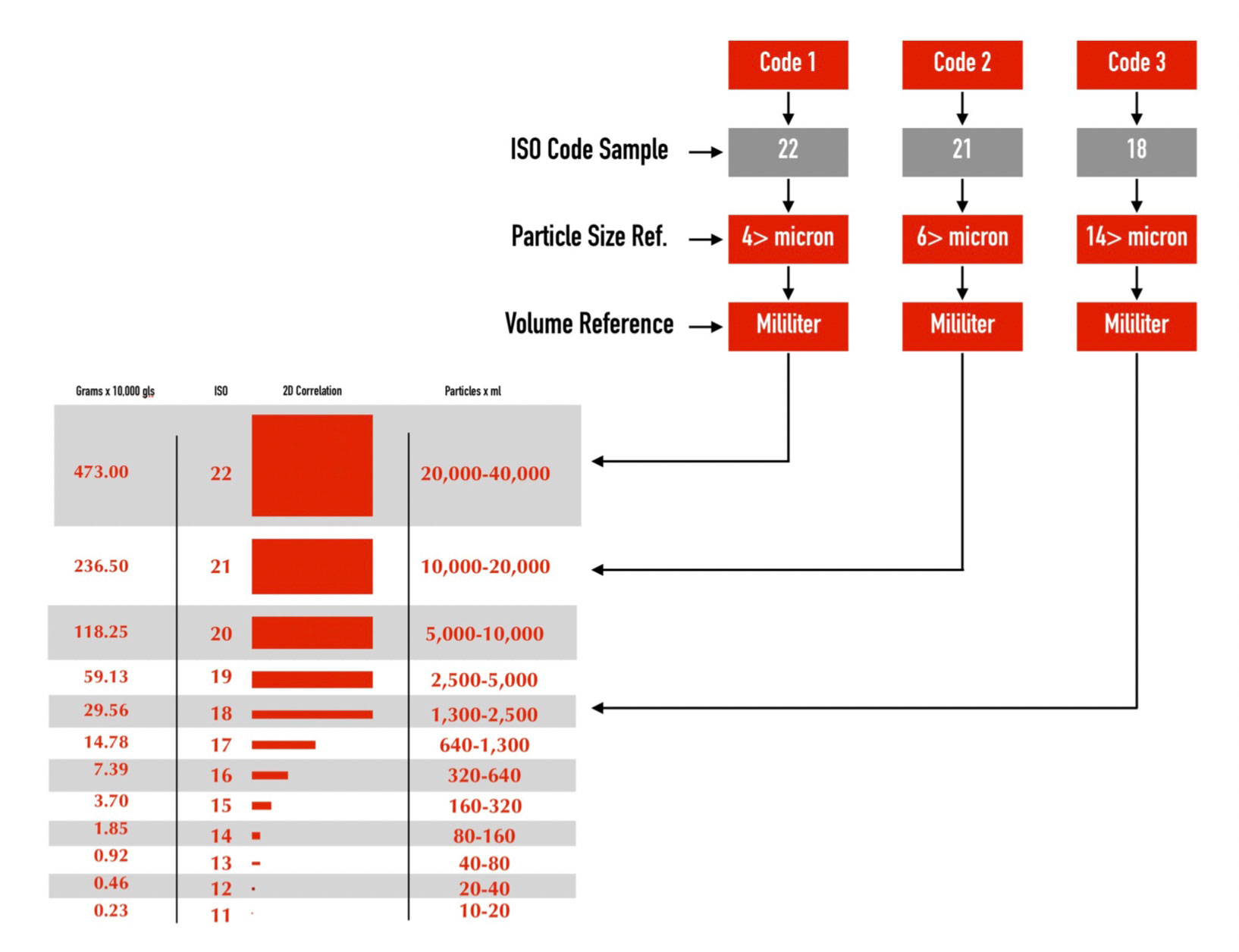
The ISO 4406 test is a granulometry analysis that is carried out on the fluid and a qualification of 3 codes is obtained:

CODE 1: particle content greater than 4 microns per ml
CODE 2: content of particles greater than 6 microns per ml
CODE 3: content of particles greater than 14 microns per ml

Depending on the type of component, OEMs define an ISO code that determines the correct operation of the system.

VISUAL COMPARISON OF CLEANLINESS IN ISO 4406 CODES

Diesel 22/20/17 (average in Latin America and Africa) vs Diesel 11/8/7 (Premium ultra-clean)

When we transition from a code 22 (473 grams of solid matter in ten thousand gallons of diesel) to a code 18 (29.6 grams of solid matter in ten thousand gallons of diesel), we remove 94% of the contamination (eliminating 443 grams of solid matter). When we transition from a code 18 to a code 11 (0.23 grams of solid matter in ten thousand gallons of diesel), we remove an additional 6% of contaminant particles (29.77 grams of contamination), with less effort compared to the cleaning done from a code 22 to a code 18. Visual representation on a digital scale of a code 11 with only 0.23 grams (less than a quarter gram) of particles in ten thousand gallons of oily fluid. Visual representation on a digital scale of a code 18 with 29 grams of solid contaminant particles in ten thousand gallons of oily fluid. Visual representation on a digital scale of a code 22 with 473 grams of solid contaminant particles in ten thousand gallons of oily fluid Microscope image of a code 22 where we see a large amount of particle contamination in different sizes Microscope image of a code 18 where a small quantity of particles is observed, however, large particles are still present Microscope image of a code 11 Ultra Clean Premium where no particles are literally visible in the fluid 473 grams of solid contaminant particles (average in Latin America and Africa) 29.6 grams of solid contaminant particles (maximum value accepted by engine manufacturers many years ago, now obsolete) 0.23 grams of solid contaminant particles (target for Ultra Clean Premium Diesel) Between 20,000 to 40,000 particles per milliliter of fuel Between 1,300 to 2,500 particles per milliliter of fuel Between 10 to 20 particles per milliliter of fuel PDFs 18/16/13 PDFs 11/08/07 Gallery 22/20/17

4 STAGES OF POWER LOSS

BAD DOSAGE

BAD DOSAGE

The injection systems require an ISO 11/8/7 diesel for dosing the fuel optimally. The wrong dosing of the injector due to the presence of particles is synonymous with loss of power and therefore greater consumption of fuel up to 5%.

COMPRESSION LOSS

COMPRESSION LOSS

The particles in the combustion chamber will cause premature wear in the cylinders, generating premature loss of compression which becomes loss of power and greater fuel consumption over the useful life of the engine of up to 7%.

CONTAMINATED LUBRICANT

CONTAMINATED LUBRICANT

The lubricant contaminated with particles raises friction and temperature, causing up to 2-3% loss of power and greater fuel consumption.

PREMATURE SATURATION OF DPF

PREMATURE SATURATION OF DPF

The pressure drop of particulate filters are causing up to 2% of loss of power and greater fuel consumption due to the combustioned particles.

INJECTOR DOSIFICATION 5% ENGINE COMPRESSION 7% OIL LUBRICATION 2-3% DPF RESTRICTION 2% Fuel Efficiency Filtration Benefits watch_later ST watch_later LT watch_later MT watch_later MT Poor dosing (5%): The injector does not produce a full and measured spray, affecting compression and temperature in the piston. SHORT TERM Loss of compression (7%): Engines lose power due to cylinder wear, worsened if the lubricant is contaminated. LONG TERM SAE tests have shown that DPF saturation generates back pressure, causing up to a 2% power loss in the engine. MEDIUM TERM Contaminated oil causes friction and high temperature, forcing the engine to use part of its power, resulting in a 2-3% loss of efficiency. MEDIUM TERM

TECHNICAL EXPLANATION

FIRST STEP TOWARDS ACHIEVING MAXIMUM POWER AND ENGINE LIFESPAN

CONSUMPTION: 10 GL/HR OIL CHANGE INTERVAL: 500 HRS VOLUME CONSUMED PER INTERVAL: 5000 GALONES search 0.00023 gr 10 GALLONS 18/16/13 0.13 gr 5000 GALLONS 11/8/3 250 gr 5000 GALLONS 22/21/18 0.5 gr 10 GALLONS 22/21/18 OIL DIESEL arrow_drop_down oil DIESEL arrow_drop_down

Defining Wear

In practice, most maintenance strategies aim to simply keep metal content below a predetermined ppm threshold… and this is incorrect!

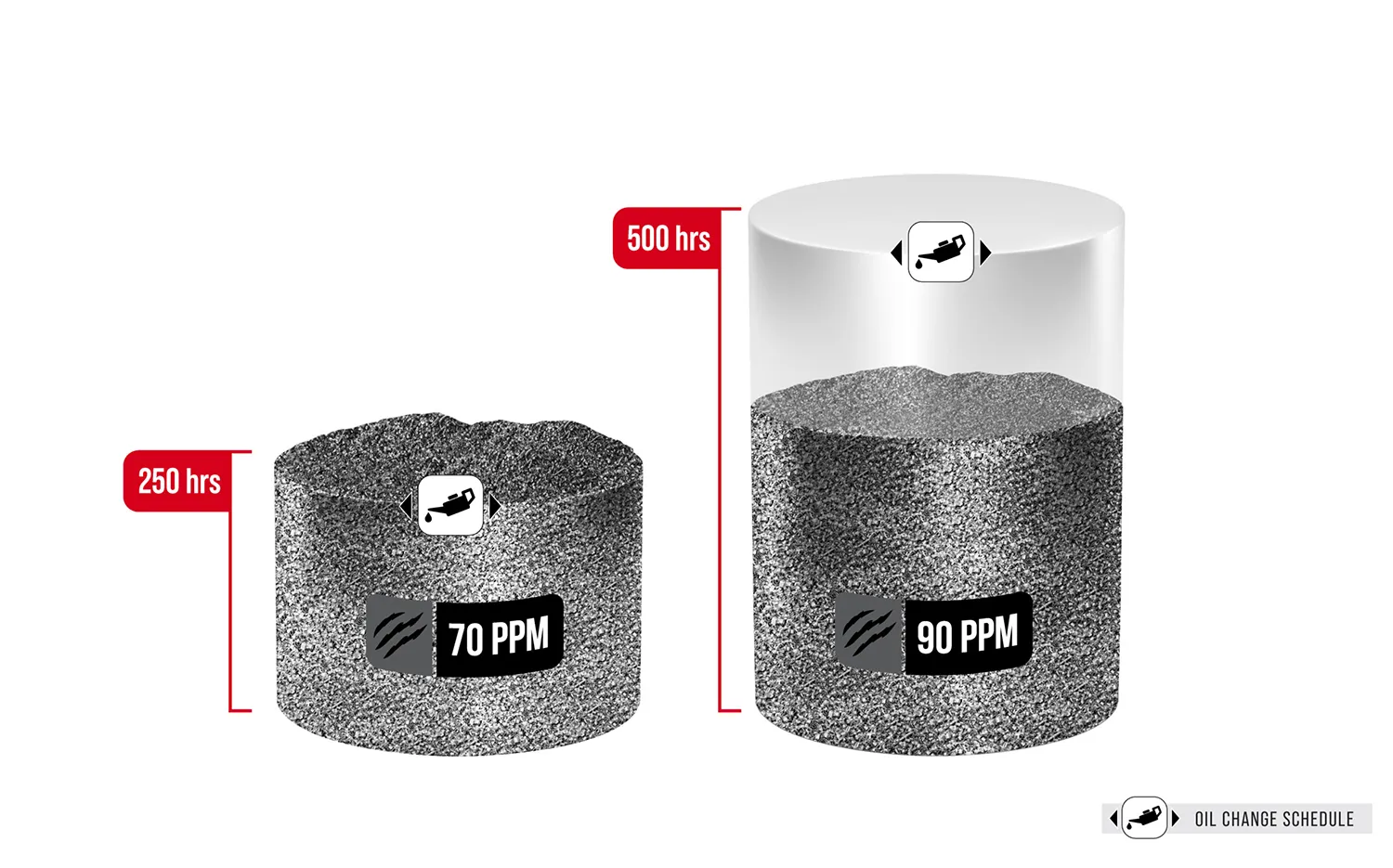
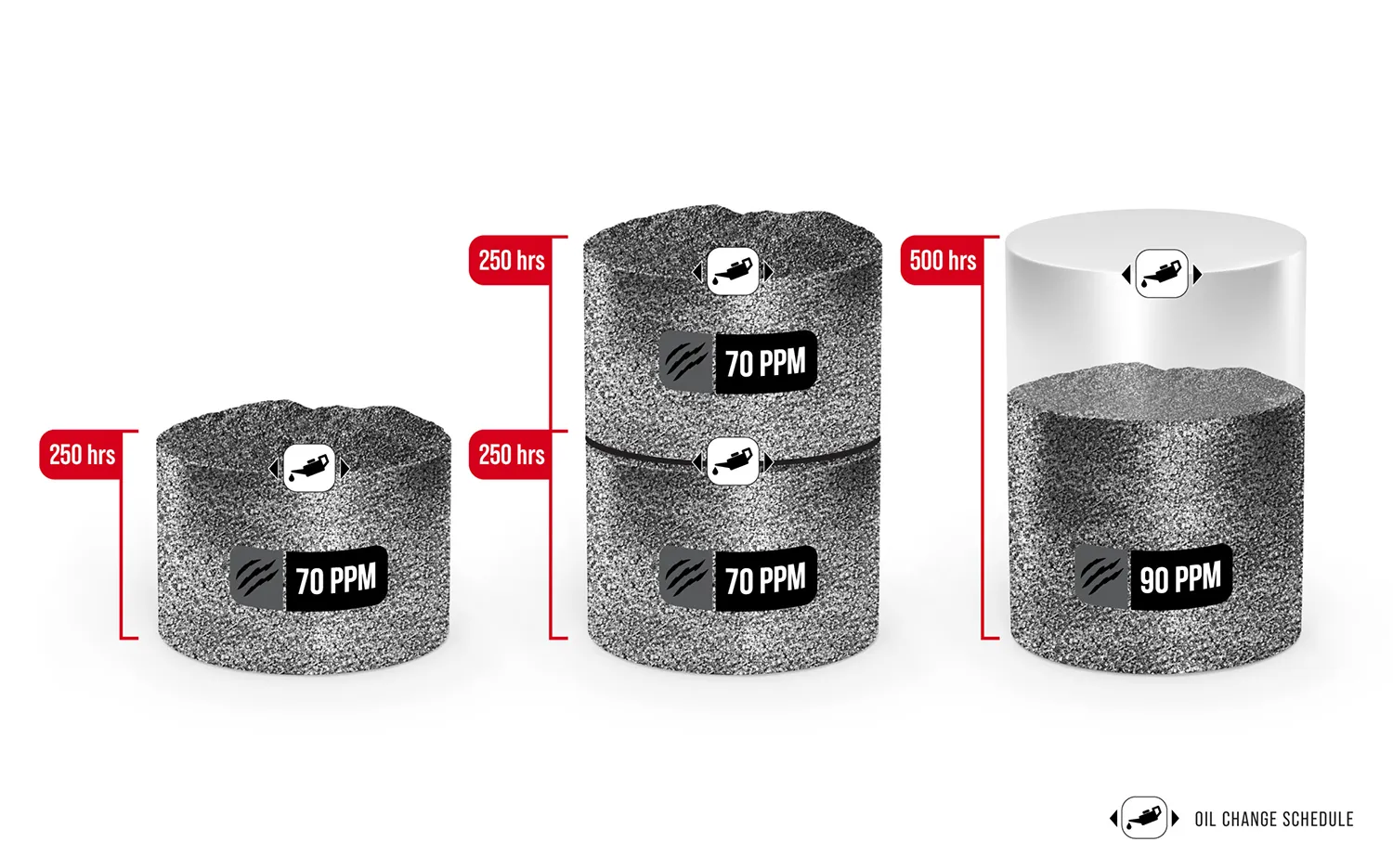
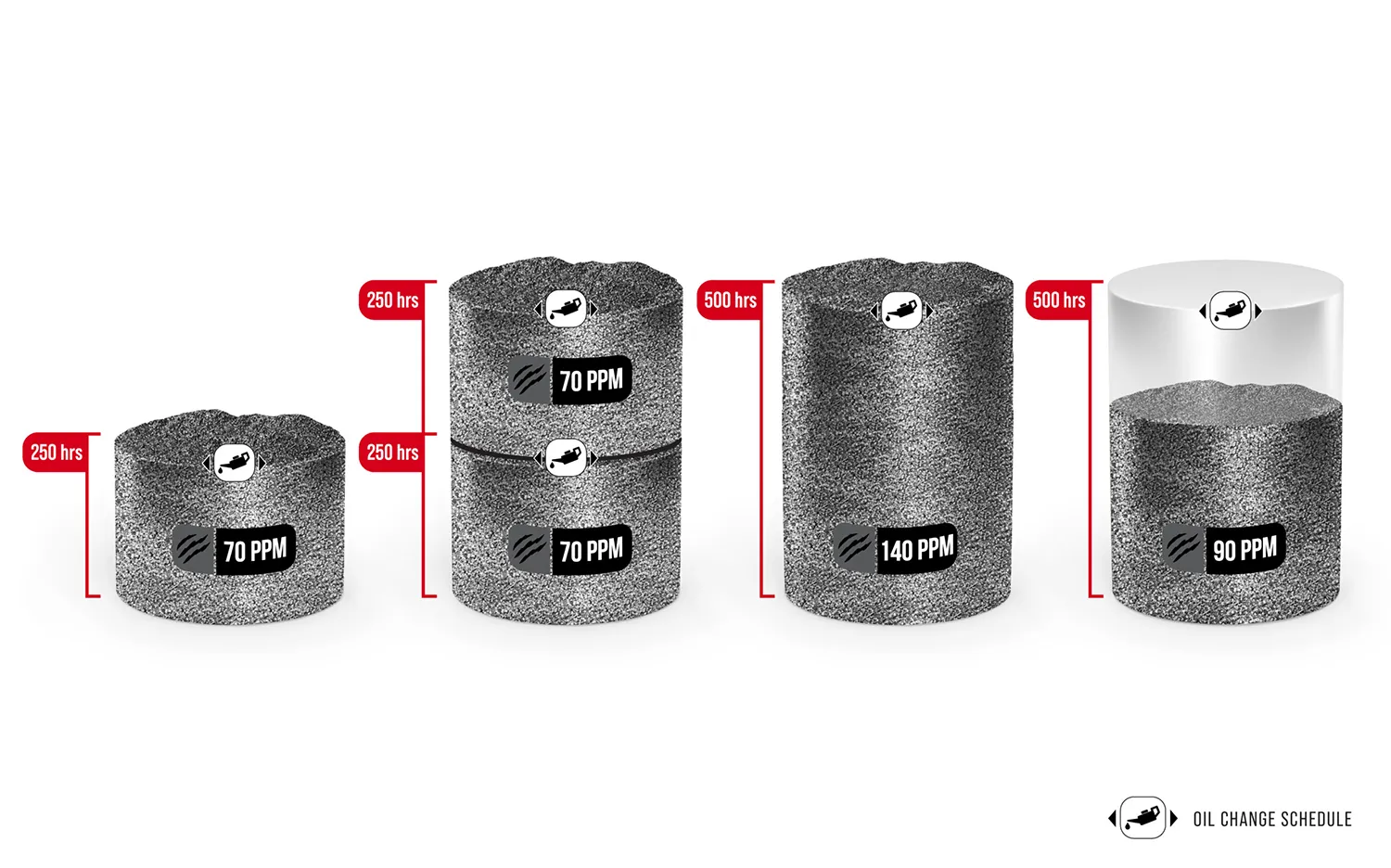
For example, many OEMs accept a maximum of 80ppm of iron in oil. An oil sample taken at 250 hours since the last oil change, showing 70ppm of iron, might give the impression that wear is within acceptable parameters. However, a sample taken at 500 hours showing 90ppm of iron might lead us to believe wear is above the allowable limit. Yet, if we look at the calculations in the attached table, the first sample at 250 hours actually shows greater wear than at 500 hours.

Oil Analysis Interpretation

Wear Rate

Following the most common assumption… If there is more than 80ppm of iron, it is necessary to reduce oil change intervals. Now let’s consider this while looking at the table: 250 hrs = 70 ppm vs 500 hrs = 90 ppm.

Logic might suggest that at 250 hours, wear is lower than at 500 hours, when in reality, at 500 hours, better lubrication is achieved.

We agree that there is no need to exceed 80ppm of iron content before an oil change. However, the key point here is not to assume that having less than 80ppm means the engine is in better condition.

Always Predictive, Never Corrective

It may seem that performing oil changes within the times established by the OEMs will keep our engine within  parameters  and  in  excellent condition.

OEMs recognize that the maximum ISO4406:99 for an engine is 17/15/12.

Carrying  out  an  oil  change above the ISO 17/15/12 code  will  generate
impacts: economic, technical and environmental.

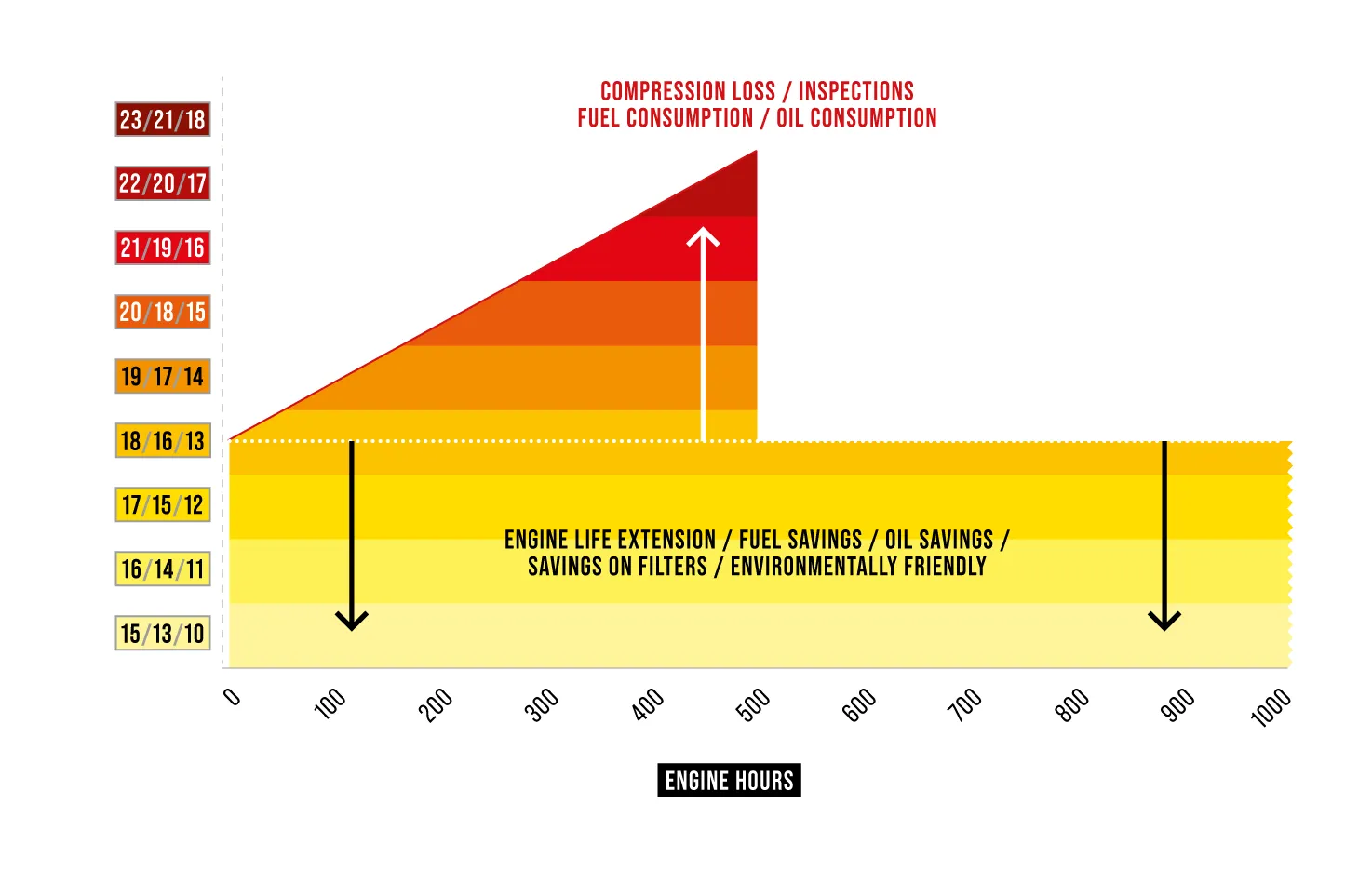
It’s a FACT, clean engines consume up to 3% less fuel.

Condition Overview

AIR OIL DIESEL GLYCOL AIR OIL DIESEL GLYCOL High Friction 3% Power Loss Reduced Interval ISO 20/18/15 0.12 g in 10 gal Poor Dosage ISO 22/21/18 125 g / 2500 gal 5% Power Loss Compression Loss 7% Power Loss AIR OIL DIESEL GLYCOL ISO 18/16/13 0.03 g / 10 gal ISO 17/15/12 0.015 g / 10 gal ISO 11/8/7 0.005 g / 2500 gal Correct Service Interval High Quality Proper Maintenance Proper Function

CONTAMINATION CONTROL

UNACCEPTABLE
UNACCEPTABLE
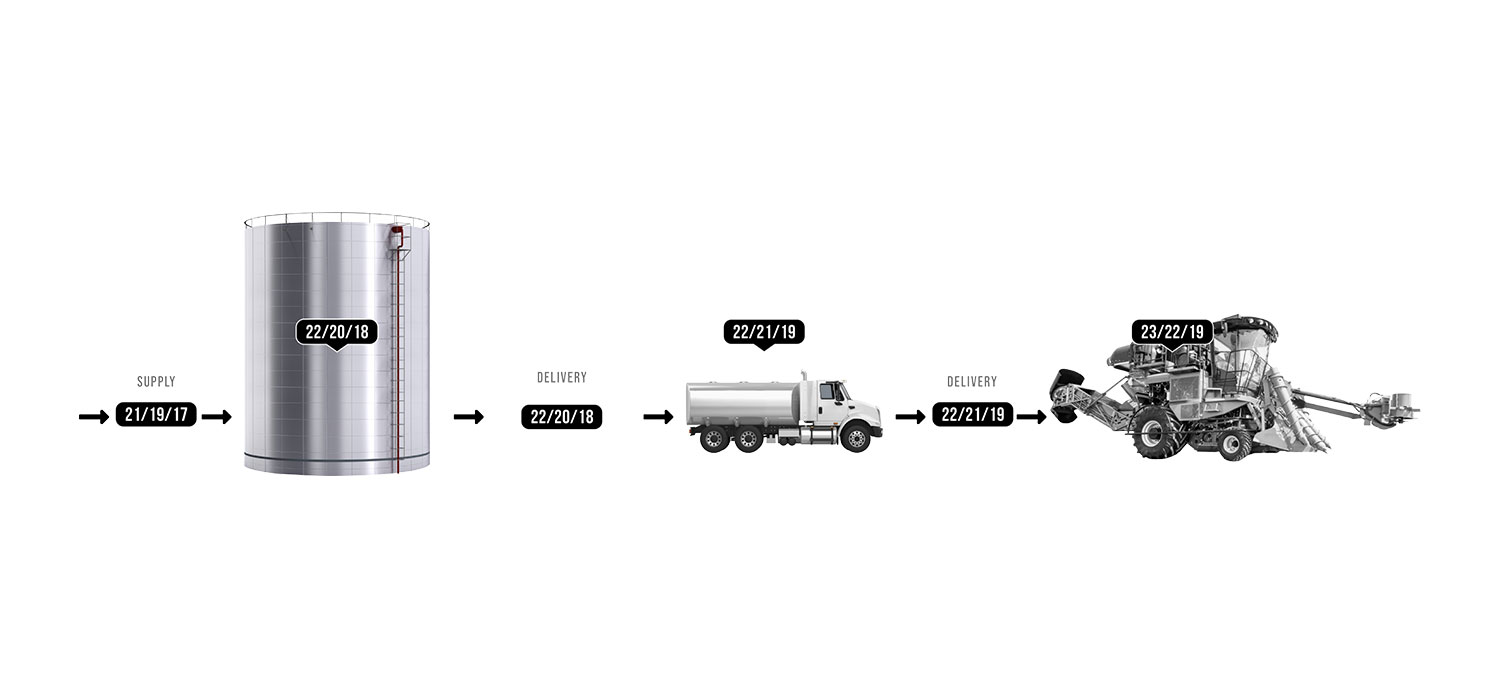
The current average diesel condition (22/20/17) in Latin America and Africa. SEE CHART
UNACCEPTABLE
BASIC
BASIC
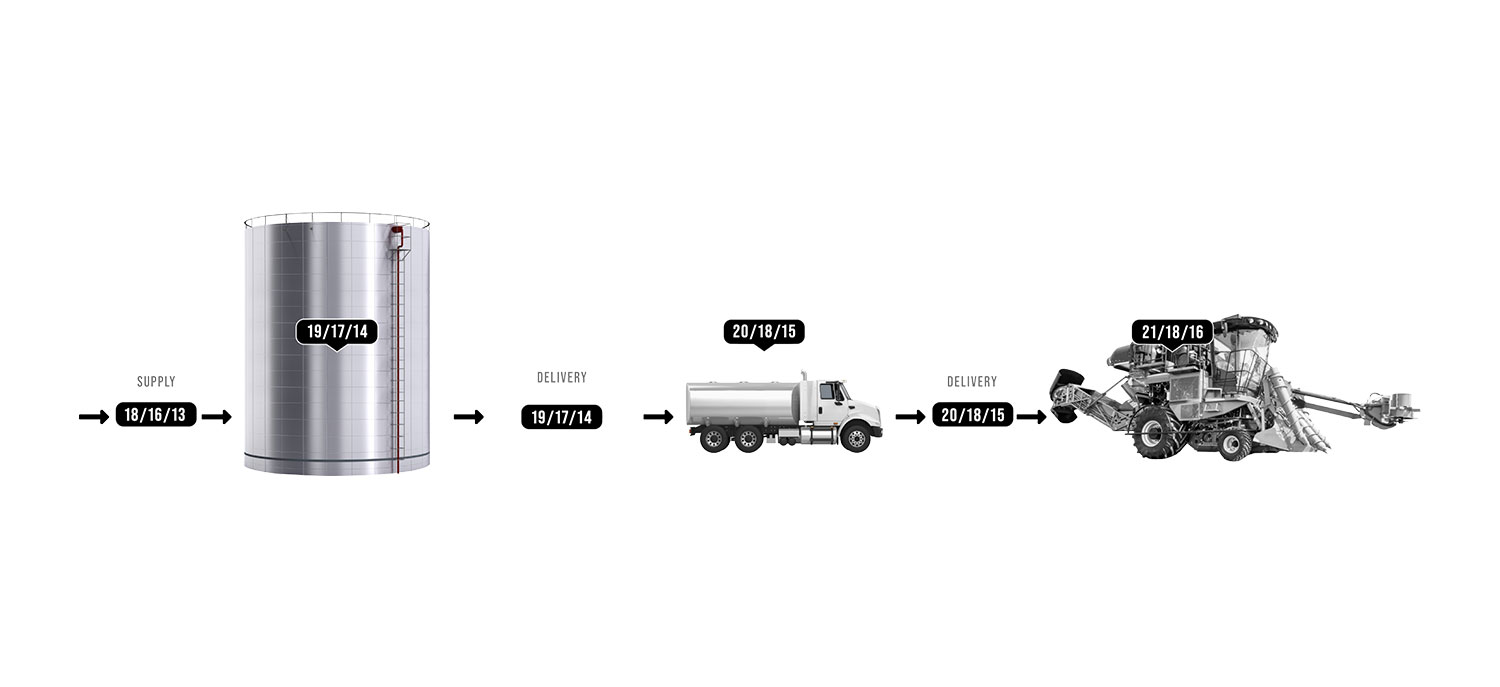
The supplier delivers ISO code 18/16/13 at the customer's reception. Contamination after this point is NOT the supplier's responsibility. SEE CHART
BASIC
BASIC PLUS
BASIC PLUS
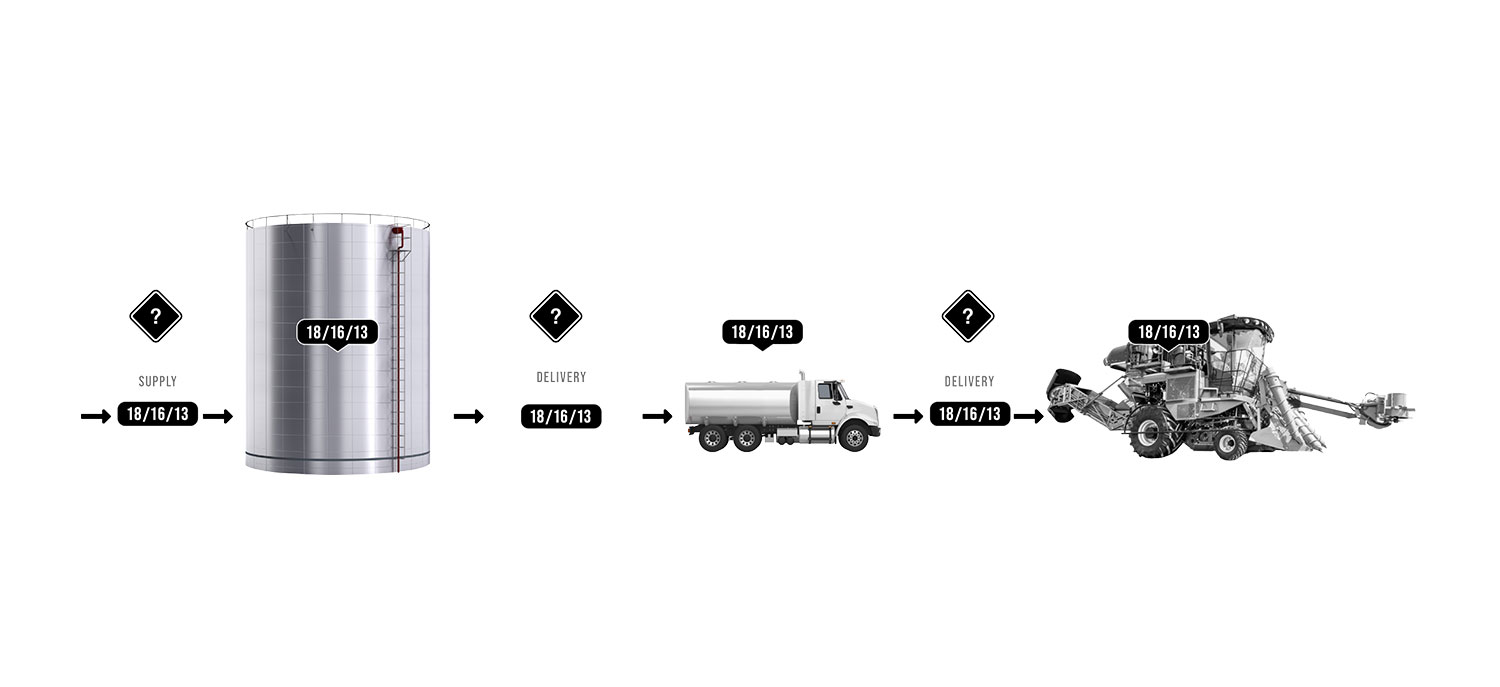
The supplier delivers ISO code 18/16/13 at the customer's reception and, by using conventional filtration systems, maintains the code up to the equipment. For this purpose, filters that reduce the ISO code by 1 per pass are required. SEE CHART
BASIC PLUS

PREMIUM EXPERIENCE

SUPPLY DELIVERY DELIVERY 21/19/17 11/8/7 14/12/10 13/11/9 <11/<8/<7 15/13/10 HYDRAULIC 16/14/12 MOTOR 11/8/7 DIESEL 400 K SUPPLY DELIVERY 3 MM 600 K 250 K DELIVERY 21/19/17 11/8/7 14/12/10 13/11/9 <11/<8/<7 15/13/10 HYDRAULIC 16/14/12 MOTOR DIESEL

The FMS Concept

DELIVERY DELIVERY SUPPLY 1 The definition of the condition of the fuel supply chain is carried out to establish the ISO condition of the client’s operation. ISO DEFINITION 1 Play Video DIAGRAM Bespoke engineering to ensure the success of the contamination control process. 2 SUPPLY
DIESEL
DELIVERY
DIESEL
DELIVERY
DIESEL
BREATHER MOTOR BYPASS BREATHER MOTOR
BYPASS
HYDRAULIC
BYPASS
BREATHER 2 View Brochures
IMPLEMENTATION From reception to the assortment of the engine! FMS delivers the necessary equipment free of charge and the customer only pays for the filter elements. 3 SUPPLY DELIVERY DELIVERY Open Gallery 3 VALIDATION The ISO results of the entire chain are validated. DELIVERY 4 DELIVERY SUPPLY Play Video MOTOR
DIESEL HYDRAULIC
4
BENEFITS Ultra clean and Ultra dry diesel guarantee the highest benefits. 5 Economic Technical Health Environmental 5 View Case Studies 4 1 1 2 3 4 5