Environmental benefits of modern technologies
Executive summary
Diesel engines have evolved over the past decades not only in terms of efficiency and durability, but also to comply with increasingly strict environmental regulations. This evolution, driven by emission control and aftertreatment systems, has transformed the environmental impact of these engines—especially regarding solid particulate matter (PM) emissions, the most critical pollutant for public health and for the technical-functional systems of engines.
This document details the differences between Tier and Euro standards, describes the key technologies at each regulatory stage, analyzes how contamination impacts engine components, and demonstrates how ultra-high-efficiency filtration (such as advanced FMS filtration) delivers environmental and technical benefits, and how these translate into economic advantages and return on investment (ROI).
1.Differences between Tier and Euro standards
The Tier and Euro standards are two emission regulation systems for diesel engines:
Tier Standard
- Primarily used in the United States by the Environmental Protection Agency (EPA) for on-road and off-road engines.
- Tier 1 through Tier 4 (including Tier 4 Final).
- These categories establish maximum allowable limits for nitrogen oxides (NOx), particulate matter (PM), hydrocarbons (HC), and carbon monoxide (CO) per unit of energy (g/kWh).
- Each stage requires increasingly advanced emission control technologies to comply with progressively stricter limits.
Euro Standard
- Primarily used in Europe and in many global markets that adopt European standards (Euro I to Euro VI).
- It also sets limits for NOx, PM, HC, CO, and, in more recent stages, particle number (PN).
- The exact figures for each stage are defined for trucks, buses, and heavy machinery in g/kWh.
For example, Euro IV, Euro V, and Euro VI represent significant consecutive reductions, including NOx and particulate reductions of more than 90% compared to earlier stages.
General equivalences
| Tier / Euro | General Comment |
|---|---|
| Tier 1 / Euro I-III | Introduction of basic NOx and PM limits. |
| Tier 2 / Euro III-IV | Advances with EGR and improved fuel injection systems. |
| Tier 3 / Euro IV-V | Introduction of particulate filters (DPF) and catalysts. |
| Tier 4 Final / Euro VI | Complex systems with mandatory DPF + SCR + DOC. Extremely low PM and NOx limits. |
2. Technological evolution of diesel engines
since Tier 3 / Euro III
We will examine the main technologies implemented at each stage to comply with emission limits and identify which ones become mandatory in each regulatory phase:
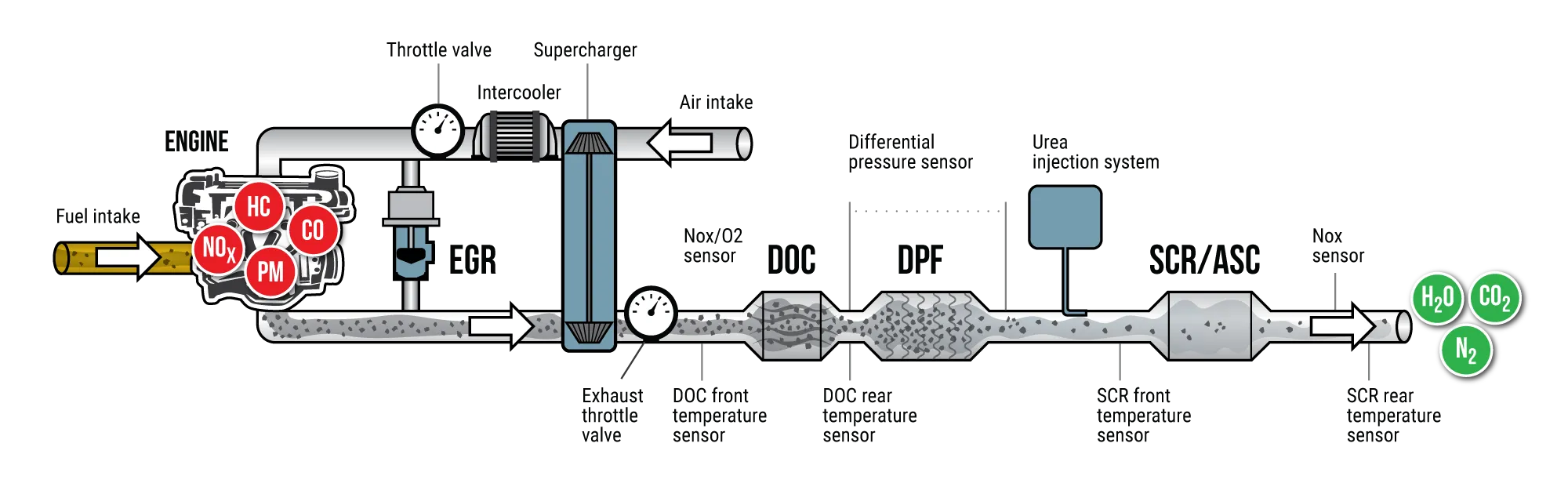
2.1 High-Pressure Injection System (HPCR / Common-Rail)
- What it is: An electronically controlled injection system that allows fuel to be injected at extremely high pressures (up to 2000 bar) and in multiple events per cycle. (Wikipedia)
- Why it is necessary: More complete combustion reduces the formation of particulate matter (PM) and NOx at the source.
- How it works: A common accumulator (common rail) maintains fuel at constant high pressure, and the ECU (electronic control unit) regulates injection timing, duration, and quantity per cylinder. (Wikipedia)
- Environmental benefit: Better fuel atomization → lower PM and CO → lower specific fuel consumption → lower total emissions (volume reduction).
2.2 Diesel Particulate Filter (DPF)
- What it is: A ceramic/porous device installed in the exhaust system that captures PM and soot before they are released into the atmosphere. (ScienceDirect)
- Why it is necessary: Solid particles are considered carcinogenic and cause serious respiratory problems.
- How it works (technical): Exhaust gases pass through a porous labyrinth that traps particles. The filter regenerates through thermal or catalytic oxidation to burn accumulated soot and prevent clogging. (ScienceDirect)
- Environmental benefit: >95% reduction in emitted particulate matter. (SKY)
2.3 Diesel Oxidation Catalyst (DOC)
- What it is: A catalyst that converts unburned CO and HC into CO₂ and H₂O and partially reduces the organic fraction of PM. (DieselNet)
- Why it is necessary: Reduces toxic gases and facilitates DPF regeneration.
- How it works: Thermally oxidizes CO and HC over catalytic surfaces (platinum, palladium, others), converting them into less harmful molecules. (DieselNet)
- Environmental benefit: Lower HC, CO, and organic fraction of PM → reduced impact on air quality.
2.4 Exhaust Gas Recirculation (EGR)
- What it is: A system that redirects a fraction of exhaust gases back into the combustion cycle. (SKY)
- Why it is necessary: Lowers peak combustion temperature, reducing the formation of NOx.
- How it works: By mixing inert exhaust gases with fresh air, peak combustion temperature decreases, which in turn reduces NOx formation.
- Environmental benefit: Lower NOx formation at the tailpipe → less smog and tropospheric ozone.
2.5 Selective Catalytic Reduction (SCR)
- What it is: A system that uses a reducing agent (urea/AdBlue) to convert NOx into N₂ and H₂O. (Wikipedia)
- Why it is necessary: NOx limits under Tier 4 / Euro VI cannot be achieved through EGR or combustion control alone.
- How it works: Diesel Exhaust Fluid (DEF/AdBlue) is injected and chemically reacts over a catalyst, converting NOx into nitrogen and water. (Wikipedia)
- Environmental benefit: Reduces NOx by more than 90% compared to engines without SCR. (Wikipedia)
3. Hypersensitivity to contamination (critical impact)
3.1 Sulfur – Although less emphasized today, sulfur content in diesel affects the efficiency of aftertreatment catalysts:
higher sulfur → catalyst poisoning → reduced NOx reduction and HC oxidation efficiency.
3.2 Water / Emulsions in Diesel
The presence of water in diesel creates emulsions that:
Affect combustion → increased PM formation.
Corrode internal components.
It is not as critical as PM, but it affects the stability of high-pressure systems.
3.3Solid Particles (PM) — The Core Challenge
Solid particles produced by incomplete combustion deposit inside:
Combustion chambers → reduce thermal efficiency over time.
Injectors and HPCR system → clogging, accelerated wear of seats and needles.
EGR system → clogging of recirculators and valves, increasing temperatures.
DPF and DOC → soot accumulation that prevents proper regeneration if not adequately filtered.
This cumulative damage increases wear, reduces efficiency, raises fuel consumption, and shortens the lifespan of costly systems (beyond the loss of environmental compliance).
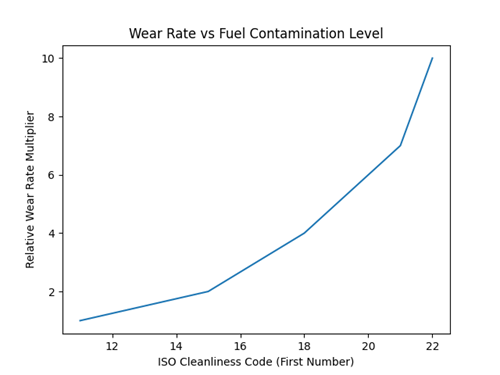
The damage becomes exponential if combustion-generated PM is not properly controlled.
4. Ultra-High Efficiency FMS Filtration
– Ingeniería de limpieza como multiplicador ambiental y energético –
4.1 Technical Foundation: Diesel Quality as a Critical System Variable
Modern diesel engines (Euro III–VI / Tier 3–4 Final) rely on micrometric tolerances:
Injector needles: 1–3 µm clearance
HPCR pumps: lapped surfaces with tolerances < 2 µm
EGR valves and differential sensors: highly sensitive to deposits
DPF: ceramic porosity calibrated for efficient PM capture
In this context, fuel with an ISO 22/21/18 code (average reported in Latin America according to field data) implies a significant solid particle load per volume.
According to quantitative analysis, this represents:
473 g of contamination per 10,000 gallons
47,300 g of removable particles per 1 million gallons
Up to 10% may migrate to the lubrication system via blow-by
This is not a minor issue. From a tribological perspective, hard particles (silica, oxides, metallic residues) cause:
Three-body abrasive wear
Micro-scratching of surfaces
Exponential increase in wear rate
Increased blow-by
Progressive loss of compression
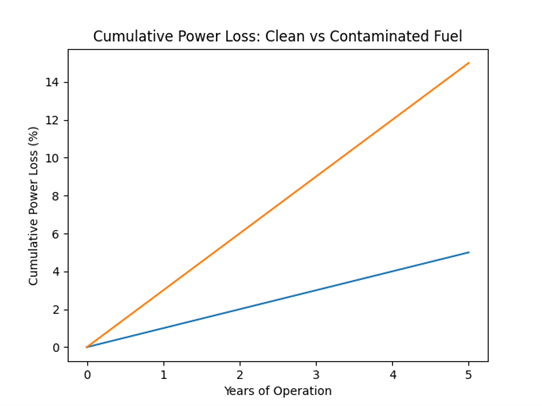
4.2 The Four Stages of Power Loss Integrated into the Technical Analysis
When an engine experiences power loss, there is not only a decrease in overall efficiency but also an increase in fuel consumption.
The magnitude of fuel consumption increase may vary in each case and would require a specific analysis of the engine in question.
| Power Loss Stage | Estimated Energy Impact | Period |
|---|---|---|
| 1. Improper dosing | Up to 5% | Short term |
| 2. Compression loss | Up to 7% | Long term |
| 3. Contaminated lubricant | 2–3% | Medium term |
| 4. Premature DPF saturation | Up to 2% | Medium term |
Total potential accumulated impact: up to 17% overconsumption
4.2.1 Stage 1: Improper Dosing (HPCR)
Particles ≥4 µm:
Erode valve seats
Alter atomization pattern
Modify closing timing
Generate incomplete combustion
Consequence:
Higher PM at the source
Higher specific fuel consumption
Greater load on the DPF
4.2.2 Stage 2: Compression Loss
Particles inside the combustion chamber:
Micro-abrasion of cylinders
Ring wear
Increased blow-by
Lower indicated mean effective pressure (IMEP)
Cumulative effect:
Exponential fuel consumption curve
Drastic reduction in service life due to accelerated wear
Sustained increase in CO₂ per unit of work
4.2.3 Stage 3: Contaminated Lubricant
Particles ≥4 µm:
5 g of contamination in 10 gallons of oil can generate >3% increase in fuel consumption
Increased friction → increased temperature → accelerated oxidation
From a tribological perspective:
Increased viscosity
Varnish formation
TBN loss
Increase in ferrous particles in spectrometric analysis
4.2.4 Stage 4: Premature DPF Saturation
Higher soot load:
Increased ΔP (pressure drop – high backpressure)
More frequent regenerations → premature critical failure
Higher fuel consumption during active regeneration
Ceramic thermal stress
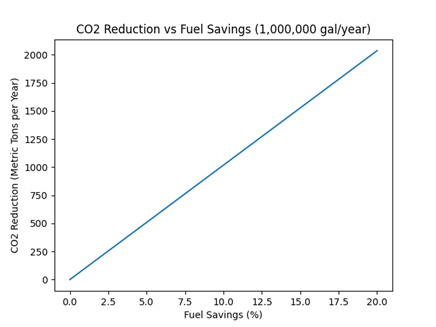
4.3 FMS Filtration: Quantitative Environmental Impact – CO₂ (EPA)
Assumptions and data:
- Assumption – Annual consumption (C): 1,000,000 gallons → 3,785,410 liters of diese
- Assumption – Estimated energy savings (A): 15% efficiency improvement
- Data – Diesel emission factor (EF): 2.69 kg CO₂ per liter (EPA / US Federal Register)
Calculation formula: (Miteco España)
CO2e = (C * A) * EFfuel / 1000
Calculation: Annual reduction: 1,527.25 metric tons of CO₂e
Environmental equivalence*: 83.33 trees per ton of CO₂ → 127,270 trees per year (Gob.MX)
* Number of trees that would need to be planted to capture X tons of CO₂ per year.
4.4 Particulate Reduction: The Environmental Core of the Model
A basic comparison between ISO 22/21/18 diesel and ISO 11/8/7 (ultra-clean) shows:
Drastic reduction of particles ≥4 µm
Significant microscopic visual difference
Elimination of dozens of kilograms of particulate matter annually
This impacts:
Direct PM emissions
Less soot generated during combustion
Indirect emissions
Lower DPF regeneration frequency → lower overconsumption → lower CO₂
Public health
PM2.5 is classified as carcinogenic (IARC/WHO)
Conclusion: Reducing formation at the source is environmentally more efficient than capturing pollutants downstream.
4.5 Differential Impact of Filtration by Euro Technology
Euro III
No mandatory DPF
Main benefit: direct PM reduction and reduced wear
Euro IV–V
DPF + EGR
Benefit: reduced premature saturation
Benefit: lower ΔP → lower energy penalty
Euro VI
Optimized DPF + SCR + DOC
Benefit: reduced catalyst poisoning
Benefit: improved thermal stability
Technical conclusion: Filtration enhances aftertreatment system performance; it does not replace it.
4.6 ULS Diesel (Ultra-Low Sulfur)
ULS:
Reduces catalyst poisoning
Improves SCR/DOC performance
However:
Does NOT eliminate solid contamination
Does NOT control water
Does NOT control particles during distribution
Therefore, ULS is a necessary—but not sufficient—condition.
4.7 Oil Life and Wear Rate Reduction
Particulate contamination ingress per typical maintenance interval:
ISO 22/21/18 → 118.25 g combustion-related contamination every 250 h
ISO 11/8/7 → <0.06 g
This implies:
Dramatic reduction of particles in the crankcase
Lower saturation of OEM filters
Reduced iron generation (Fe ppm) in oil analysis
Extended service intervals
Reduced waste used oil (ALU) generation (indirect environmental benefit)
Key principle:
Oil life extension is a consequence of engine life extension.
4.8 Integrated Technical Synthesis
Ultra-high-efficiency filtration delivers:
Mechanical benefit
Reduced wear
Sustained compression
Greater effective power
Energy benefit
Up to 17% fuel consumption reduction (four-stage model)
Environmental benefit
1,527 t CO₂e avoided per million gallons
47,300 g of particles removed annually per million gallons
Lower PM emissions
Systemic benefit
Extended HPCR life
Extended and more stable DPF life
Improved SCR efficiency
Reduced forced regenerations
Lower residual oil generation
Strategic Conclusion for Maintenance Directors
Modern engines are already environmentally advanced by regulatory design (Tier/Euro standards).
However:
They are hypersensitive to contamination.
The real efficiency of the system critically depends on fuel cleanliness.
Therefore, ultra-high-efficiency filtration is not an accessory:
- It is an energy-efficiency multiplier,
- a capital protection strategy,
- and a direct carbon footprint reduction strategy.
5. Economic Benefits of Modern Diesel Engines
The economic benefits associated with these technologies include:
Reduced fuel costs due to improved combustion efficiency.
Lower maintenance costs due to reduced PM accumulation, less wear, extended service intervals, and lower use of consumables.
Longer service life of HPCR systems, injectors, turbochargers, and aftertreatment components.
Reduced risk of regulatory fines related to emissions.
Improved corporate reputation and environmental compliance.
Increased machine uptime with fewer shutdowns for cleaning/regeneration.
5.1 Cost-Benefit Analysis and ROI
By investing in modern technology and advanced filtration:
Higher initial costs are offset by lower fuel consumption, fewer failures, longer service life, and reduced downtime.
ROI can be achieved within months to a few years, depending on the operating cycle and fuel consumption.
6. Call to Action
Companies operating diesel fleets must:
Evaluate upgrading engines to Euro V standards or higher equivalent Tier levels.
Incorporate advanced filtration technologies (ultra-clean diesel) to maximize service life and efficiency.
Monitor and optimize aftertreatment systems to ensure environmental compliance and operational efficiency.
References
[1] Emisiones y tecnologías de control para motores diésel — estudios MEC a EPA, ICCT y registros técnicos internacionales. (meca.org)
[2] Comparación de tecnología DPF vs SCR y otros sistemas de post-tratamiento. (SKY environmental technologies)
[3] Evolución de sistemas de inyección diésel como common-rail. (Scribd)
[4] Normativas Euro y sus límites de emisiones a lo largo de las generaciones. (Q8Oils)
[5] Literatura médica sobre reducción de emisiones de partículas con filtros dedicados. (PMC)
[6] SCR y uso de AdBlue para reducción de NOx. (Wikipedia)
[7] La paradoja Latinoamericana de la limpieza — FMS
[8] Los beneficios del diésel limpio y el debate de los límites — NORIA