Proactive Maintenance RCM – Reliability Centered Maintenance is the set of preventive and predictive strategies designed to prevent failures before they occur. These strategies are grouped under this term because they share a common philosophy: acting in advance to extend the useful life of machinery and avoid unplanned downtime. Unlike reactive maintenance, which only responds after a failure has occurred, RCM is based on the implementation of strategies, inspections, planned repairs, and continuous condition monitoring. This approach not only optimizes and increases operational performance, but also reduces multiple costs, generating a significant return on investment (ROI) that makes it a strategic investment for any organization.
How to Calculate the ROI of Proactive Maintenance
The ROI of proactive maintenance is calculated by comparing the net benefits obtained with the costs incurred. The basic formula is:
RCM ROI = (Net Benefits of RCM* – RCM Costs**) / RCM Costs
Proactive Maintenance Costs (Investment) – These include consulting services, labor, materials, and parts required for the implementation of the selected strategy; supervision and training of personnel to execute the strategy; and the cost of technology (such as a Computerized Maintenance Management System, CMMS), if used.
Net Benefits of Proactive Maintenance (Return) – These are the savings and gains generated, which include six key aspects:
Reduction in repair costs – NORIA Corporation, the world’s most prestigious institution in fluid management, has established that lubricant contamination is the number one cause of failures in hydraulic systems. A properly implemented Proactive Maintenance strategy reduces component wear, cutting machinery failures and repairs by more than half, and proportionally reducing annual spare parts purchases and workshop expenses. The U.S. Department of Energy also notes that proactive maintenance can reduce emergency repair costs by up to 60%.
Reduction of unplanned downtime – According to STLE (Society of Tribologists and Lubrication Engineers) and NRCC (the world’s largest oil and petroleum spill response organization), two out of three catastrophic failures are attributed to abrasive wear. Unexpected production shutdowns are extremely costly, especially in critical machinery, and may involve significant occupational and environmental risks. Proactive Maintenance minimizes these undesired events and interruptions, resulting in higher reliability, operational efficiency, and productivity.
Extension of asset service life – Extensive documentation from manufacturers and tribology experts indicates that more than 80% of mechanical wear is caused by particulate contamination in hydraulic systems. Optimal and systematic protection, validated through regular monitoring, extends the service life of machinery and its components to at least twice their original lifespan, and in some cases by more than 10 times.
Extension of the service life of frequently purchased consumables – Proactive Maintenance focused on industrial fluid cleanliness can significantly extend the service life of consumables such as lubricating oils and OEM filters. This results in substantial annual reductions in procurement budgets for these items.
Improved safety, production schedules, and reduction of penalties – A proactive maintenance program reduces safety incidents by at least 50% and helps ensure compliance with regulatory requirements and production targets.
Energy cost savings – Regular maintenance activities, such as cleaning HVAC systems, can improve energy efficiency by up to 15%, leading to reduced utility costs.
From Example to Calculator: Two Key
Resources to Understand ROI

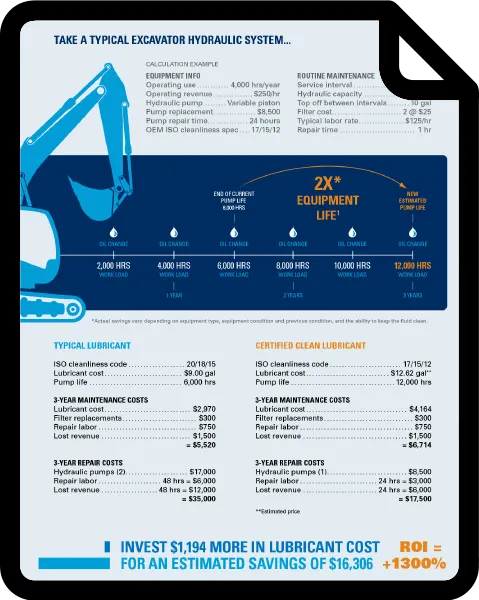
Chevron Infographic
It presents a practical and simple example of how to calculate return on investment when the service life of components and fluids is doubled. At FMS, with our filtration solutions, we have achieved service life extensions of up to 4X.
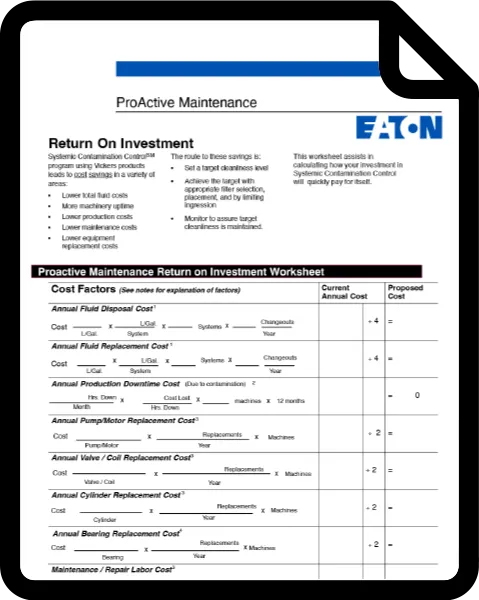
VICKERS CALCULATOR
An easy-to-use tool that allows you to directly estimate the return on investment.

Strategies to Maximize the Value
of Proactive Maintenance
To ensure a high ROI, it is crucial to implement a Proactive Maintenance RCM program effectively. This includes:

Card #1

Card #2

Card #3

Card #4
Conclusion
Proactive Maintenance is not an expense; it is a strategic investment that generates a significant, real, and verifiable return on investment, improving a company’s overall reliability and operational performance.
By extending the service life of equipment and consumables, improving safety, preventing failures, and reducing costs, a well-implemented Proactive Maintenance program—supported by FMS high-efficiency ultrafiltration technology—delivers high-impact results, progressively driving profitability in the short, medium, and long term, with an ROI exceeding 1,500%.